What one deal decides
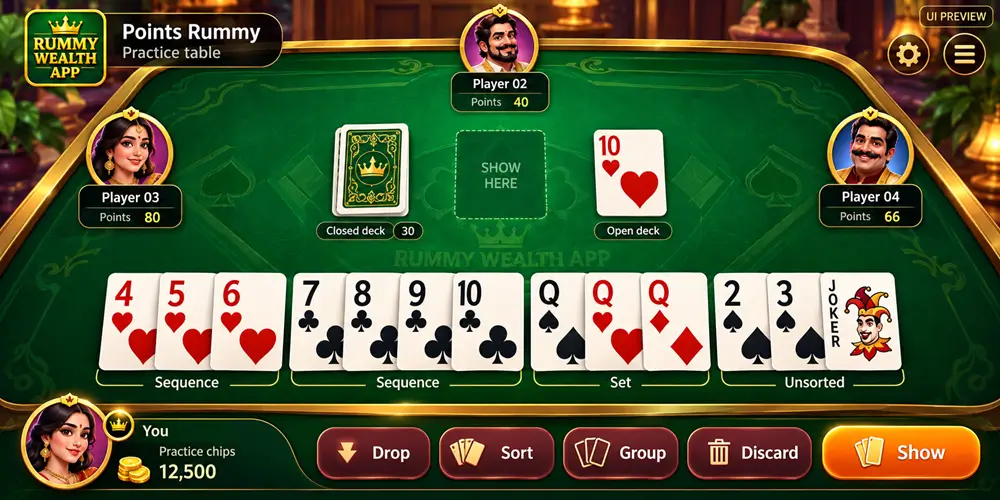
In common Indian points rummy, each player receives 13 cards. The deal ends when a player makes a valid declaration, or when the closed deck is exhausted under that table’s rules. Unmatched cards are then counted. A valid declaration usually scores zero. Everyone else is scored on the cards that are not in a permitted group.
The rupee value of one point, if any, is a setting of the table you joined. This website does not run tables and does not publish a point rate.
The groups that count
A typical valid hand needs at least two sequences, and one of them must be a pure sequence. Remaining cards sit in sequences or sets. A joker can fill a gap in an impure sequence or stand in for a missing card in a set. It cannot replace the pure sequence.
आम पॉइंट्स रमी में एक डील अलग से गिनी जाती है। वैध घोषणा के लिए आमतौर पर कम से कम एक प्योर सीक्वेंस जरूरी होता है।
Leaving a deal early
Many points tables let a player drop before arranging the full hand. An early drop is usually charged fewer points than a full unmatched hand, and a later drop costs more. The exact figures, and whether a drop is even allowed after you have drawn, belong to that table’s rule card.
This site does not print a first-drop or middle-drop number, because copying another app’s figure would describe their table, not ours.
Read the count next
Card values are explained in card points and scoring. Longer sittings use pool rummy or a fixed number of deals. The shared grouping rules are on how to play.