Common table parameters
These figures are the usual Indian 13-card convention. They are not a published Rummy Wealth cash table, and a particular room can set a different drop score or point cap.
| Parameter | Usual 13-card practice |
|---|---|
| Players at one table | 2 to 6 |
| Decks | 2 decks, including the printed jokers |
| Cards dealt | 13 |
| Valid declaration | At least two sequences, one of them pure, every other card grouped |
| Pure sequence | 3 or more consecutive cards of one suit, no joker filling a gap |
| Set | 3 or 4 cards of the same rank in different suits |
| Unmatched ace, king, queen, jack | 10 points each |
| Unmatched 2 to 10 | The number printed on the card |
| Joker used as a substitute | 0 points |
| Points sitting | One deal is scored, then the next hand starts clean |
| Pool sitting | Running total to 101 or 201 |
| Deals sitting | Usually 2 or 3 deals, then the totals are compared |
आम 13 पत्तों की रमी में 2 से 6 खिलाड़ी, दो डेक और 13 कार्ड होते हैं। वैध घोषणा के लिए कम से कम एक प्योर सीक्वेंस चाहिए।
What you are trying to make
In common 13-card Indian rummy, you arrange your hand into valid sequences and sets. A typical valid declaration requires at least two sequences, including at least one pure sequence, with all remaining cards in permitted groups.
The exact table rules matter: scoring, drops, joker handling and declaration penalties can differ. Read those rules before beginning any game. The examples below explain common combinations without stakes.
Start with a pure sequence
A pure sequence contains at least three consecutive cards of the same suit, with no joker substituting for a missing card. These three hearts form a pure sequence:
Changing the middle card to 5♣ breaks the sequence because the suits no longer match. A wild card used as its natural rank and suit can be treated differently by table rules; check the rulebook.
Sets and joker-assisted sequences
A set groups cards of the same rank from different suits, such as 8♠–8♥–8♦. It is different from a sequence, which follows consecutive ranks in one suit.
In a sequence that permits a substitute, a joker can represent a missing card. For example, 7♣–Joker–9♣ can represent 7♣–8♣–9♣. This is not a pure sequence. A joker cannot replace the required natural pure sequence.
What happens on a turn
-
Draw a card
Choose from the closed pile or the visible discard pile, as allowed by the table rules.
-
Review your combinations
Look for a pure sequence, a second sequence and useful sets. Recheck the suit and rank of each card.
-
Discard one card
Keep the hand size required by the game. Consider how the discard affects your remaining groups.
-
Declare only after checking
Review every card and confirm that the full hand meets the table’s declaration rules.
A complete example
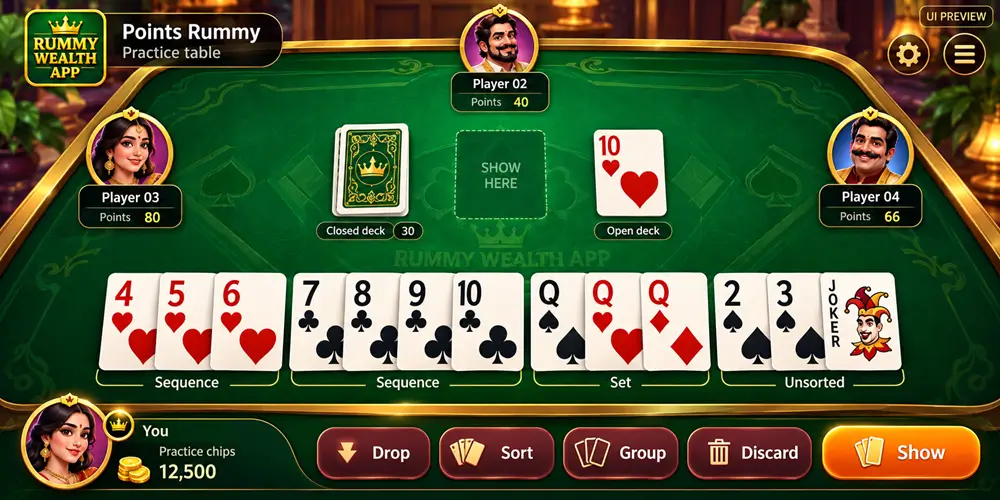
The following groups use 13 cards: 4♥–5♥–6♥; 7♣–8♣–9♣; Q♠–Q♥–Q♦; and 2♠–3♠–4♠–5♠. The hand has natural sequences and a set, with every card accounted for.
This example shows the grouping logic. It is not a prediction of what you will draw or a strategy that guarantees a result.
Three ways a sitting ends
The cards are grouped the same way. The sitting is not.
- Points rummy scores one deal, then starts again.
- Pool rummy adds points toward 101 or 201 and drops a player who reaches the line.
- Deals rummy plays a fixed number of deals and compares the totals.
Face cards usually count 10, number cards count their face value, and a joker used as a substitute counts 0. The full table, including why a cap of 80 is not universal, is in card points and scoring. Unfamiliar words are in the glossary.
Practise the decisions
Use ordinary playing cards or a permitted free practice environment to recognise combinations. Focus on suit consistency, the value of connected cards and checking a full hand before declaring.
For a closer look at the most important first combination, read our pure sequence guide. Keep play recreational and take regular breaks.